
The battle to build more powerful AI PCs is moving beyond simple chatbot features.
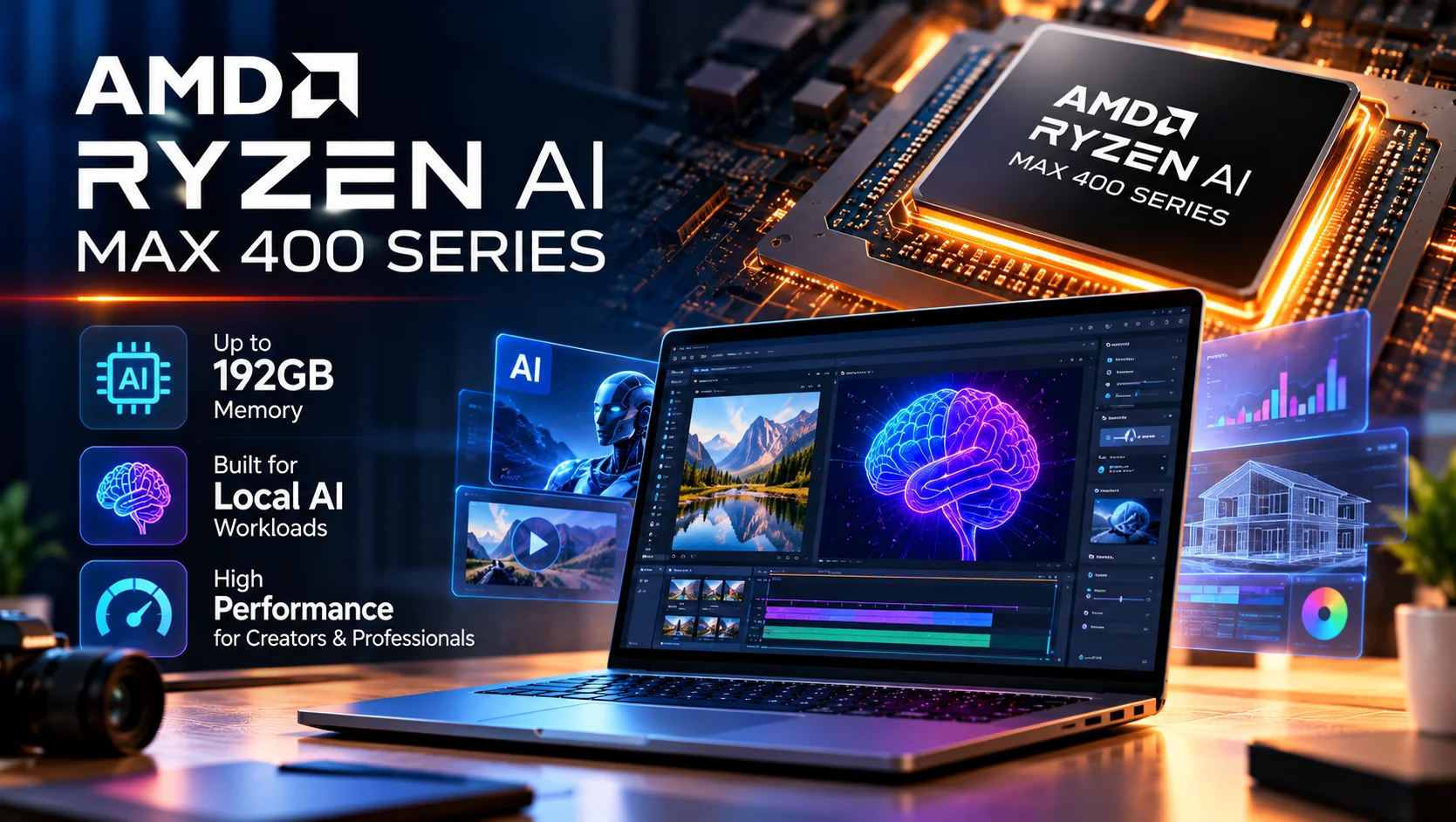
AMD’s latest Ryzen AI Max and Ryzen AI Max PRO 400 Series processors are designed to run significantly larger artificial intelligence workloads directly on a PC.
One specification immediately stands out.
Systems based on the new processors can offer as much as 192GB of unified memory, with up to 160GB available for GPU workloads.
That is far beyond the amount of memory found in a typical consumer laptop.
But these are not ordinary PCs.
AMD is targeting developers, businesses, mobile workstations and users who want to run demanding AI models locally rather than depending entirely on cloud computing.
Table of Contents
Why Does an AI PC Need So Much Memory?
Running a large AI model locally can require an enormous amount of memory.
Traditional PCs divide workloads between system RAM and dedicated graphics memory.
AMD’s approach uses a large unified memory pool that can be allocated more flexibly between different computing tasks.
The Ryzen AI Max 400 Series increases that capacity considerably compared with the previous generation.
Earlier Ryzen AI Max 300 Series systems could offer up to 128GB of total memory, with up to 96GB available to GPU workloads.
The new generation raises those figures to 192GB and 160GB respectively.
That additional capacity could allow developers to experiment with AI models that would otherwise require specialised hardware or cloud infrastructure.
AMD Wants More AI to Stay on Your PC
The wider objective is to move increasingly sophisticated AI workloads away from remote data centres and onto local hardware.
There are several potential benefits.
Local processing can work without depending constantly on an internet connection.
Sensitive information can remain on the user’s own machine for suitable applications.
Latency can also be reduced because data does not always need to travel to a remote server before a result is returned.
For businesses working with confidential information, those advantages could be particularly attractive.
More Than Just an NPU
Modern AI laptops are frequently marketed using NPU performance.
AMD’s new platform demonstrates why the future of local AI will involve more than one specification.
The Ryzen AI Max and Max PRO 400 Series can combine up to 16 Zen 5 CPU cores, integrated RDNA 3.5 graphics and an XDNA 2 NPU rated at up to 55 TOPS.
Different AI workloads can therefore use different parts of the processor depending on their requirements.
Large language models, for example, can be particularly demanding on memory capacity and GPU resources.
Huge AI Models on an x86 PC
AMD says its Ryzen AI Max PRO 400 Series can run AI models exceeding 300 billion parameters when using 4-bit quantisation without requiring cloud offload.
That is a manufacturer claim and real-world performance will depend on the model, software configuration and workload.
Independent testing will therefore remain important.
Nevertheless, the direction of travel is clear.
The AI PC market is moving beyond lightweight assistants and background effects.
Manufacturers are beginning to build computers designed to run much larger AI workloads locally.
What Does This Mean for Normal Laptop Buyers?
Most people do not need 192GB of memory today.
A student browsing the web, an office worker using Microsoft 365 or even a typical PC gamer would struggle to justify that amount purely for conventional computing.
But high-end hardware often provides an early indication of where mainstream technology is heading.
AI workloads could eventually become another factor laptop buyers consider alongside CPU speed, graphics performance, battery life and display quality.
Instead of simply asking whether a laptop has an NPU, buyers may start asking what size of AI model it can realistically run offline.
That would represent a significant change in the way PCs are compared.
AMD’s latest hardware suggests that the industry is already preparing for it.
